Tattoo styles
Cybersigilism
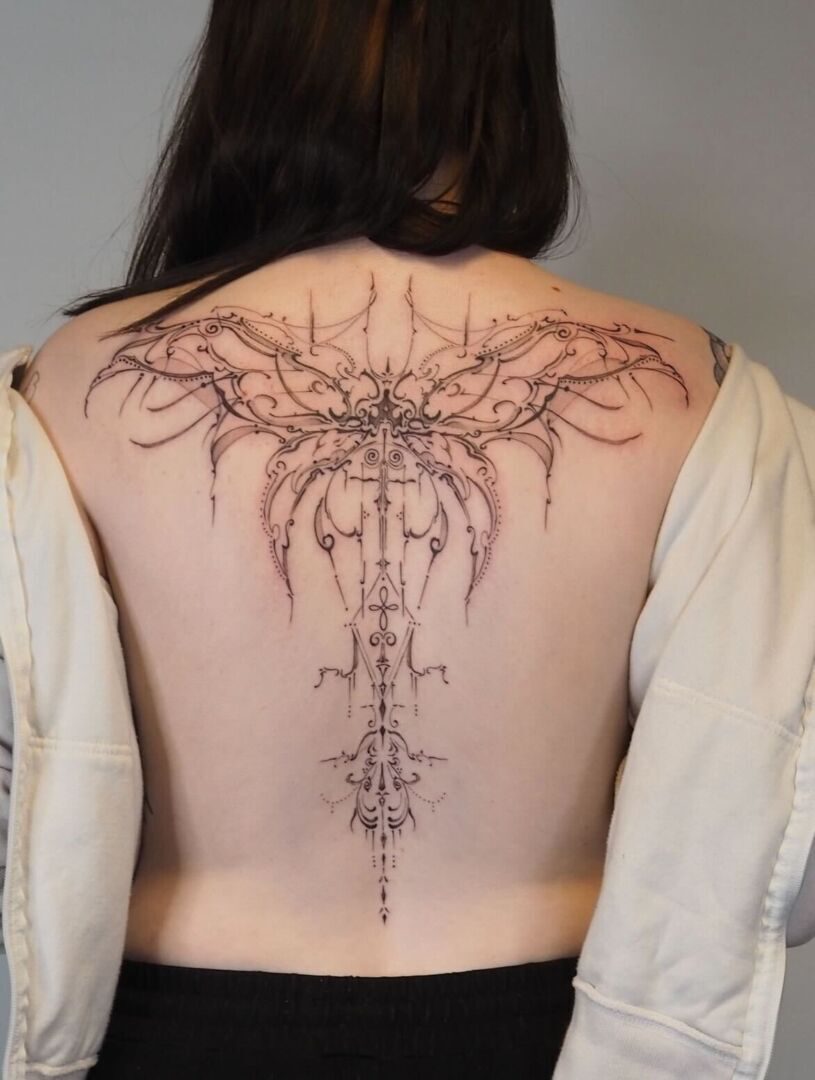
From Berlin’s bathroom walls to Balenciaga and Billie Eilish – the tattoo style that blends the ancient with the new, the supernatural with the futuristic.
Like an aggressive spiderweb, jagged lines stretch across the body in chaotic, quasi-geometric forms. Incomprehensible veins on the outside of the skin, turned at sharp angles with protruding thorns – yet even within the aggression there is something delicate and fragile. It is an aesthetic on the borderline between a curse from a grimoire and the design of a circuit board. You’ve seen it on social media, on logos, clothing and the skin of celebrities. You recognise it, but you may not know what it’s called.
It’s Cybersigilism.
The word, much like the style itself, is composed of old and new. Cyber carries associations with the digital and the futuristic, while sigil refers to magical symbols. In antiquity, sigils were conceived as representations of angels and demons, but in the 1970s chaos magic emerged in England in step with punk and counterculture. It was a more radical form of occultism that used sigils as carriers of intention; something that condenses complex ideas into a single symbol.
The aesthetic of cybersigilism boils down to this duality: ancient symbols adapted with the aesthetics of the digital age.
Cloaked in darkness
Cybersigilism as we know it today was forged in the heat of sweating bodies on Berlin’s techno clubs in the late 2010s. On club scenes where people dressed skimpily and everyone was tattooed, there was a growing need for tattoos that marked the subculture you belonged to – to more clearly show whether you were part of the scene or a “tourist” in the scene. Cybersigilism became a visual membership card to the authentic techno community – the style’s origins had many roots, and was used as much for identification of belonging as a sign of distance from minimalism’s invasion of aesthetics. Things like the 2010s Clean Girl and Normcore styles.
The designs started as subcultural markers in club queues and on bathroom walls, and quickly evolved into markers on the body itself.
The artistic roots
H.R. Giger’s biomechanical nightmares
What started with a scrappy adaptation of the Dune books in the 1970s led to the artist H.R. Giger having his art presented to the world through the xenomorphs of Alien. His biomechanical nightmare visions of the futuristic became defining for how we visualise dark sci-fi today. His art is a blend of the organic and the biomechanical that merges into distorted patterns equally inclined to provoke disgust as curiosity.
The intricate patterns cybersigilism plays out on are unmistakably Giger’s legacy, but where Giger’s biomechanics concerned the machine replacing the body (a physical robot), cybersigilism is about cybernetics – the ghost in the machine. Can AI become self-aware? And how will technology integrate into human lives and change the way we live? These are the questions explored in cybersigilism’s aesthetic.
Christophe Szpajdel’s chaotic typography
Known as the “Lord of the Logos,” he is the man associated with black metal logos and the near-illegible font that has become more or less the norm. He has created over 10,000 logos for bands including Emperor and Moonspell. His spiky, organic and at times illegible typography is the direct ancestor of cybersigilism’s aggressive and sprawling aesthetic.
Austin Osman Spare and chaos magic
The concept of the sigil changed meaning in the 1970s under chaos magic’s guidance. They built their foundation particularly on Austin Osman Spare’s writings on sigils. Spare was a British artist and occultist who presented his ideas on magic and rebirth in the book “The Book of Pleasure” in 1913.
The designs in cybersigilism represent, much like Spare’s sigils, personal philosophy, ambitions and modern interpretations of ancient occultism, sealed within the bearer of the design. Cybersigilism has sealed a generation’s experiences, anxieties and longings into their skin with ink. It embraces the posthuman: the idea that our identity is interwoven with the digital and that the body can and should reflect this.
In a world that feels increasingly uncontrollable, the tattoo is a sigil – an ancient symbol threaded into cybernetic armour to protect modern souls.
Neotribal and the 90s legacy
Leo Zulueta is considered the father of modern tribal tattooing. His distinctive style, called neotribal, became the defining tattoo style of the 1990s, recognisable by its thick, blocky lines and geometric patterns. The style evolved to incorporate more futuristic elements in the 2000s.
The connection between cybersigilism and neotribal is the style’s most controversial aspect, as it is linked to questions of cultural appropriation. When it comes down to it, it’s mostly about what the motif draws inspiration from, since the style itself builds on a wide spectrum of art movements and traditions. Cybersigilism can build on archaic patterns; it can build on technology or organic forms like hearts, stars and wings made abstract.
In cybersigilism, the intention is directed toward bodily autonomy and self-expression; the individual’s ownership of and modification of their own body. Gen Z has described it as character modifications – much like how you can modify your own Sim in The Sims. It is also celebrated by many queer people, especially trans individuals, as gender-affirming self-care.
Tattoo artist Aingelblood rejects the neotribal label and emphasises that tribal tattoos should be reserved for the cultures that have long practised them, with purpose and historical meaning, and that this differs from the more abstract and ornamental art of cybersigilism. Serious artists and clients are conscious of this distinction and focus on creating original designs that are personally meaningful, rather than copying sacred symbols.

In conclusion, one can say it is impossible to fully separate cybersigilism from neotribal tattoos, because it depends on the motif, but authentic cybersigilism is distinctly different in execution and intention.
Looking at actors Jason Momoa and The Rock, both have beautiful tribal tattoos to honour their cultural heritage. In contrast, the artist Grimes with her red cybersigilism tattoos leaning toward the gothic, spiritual and futuristic, underscores her as an individual rather than a celebration of cultural and social heritage.
When cybersigilism is called Gen Z’s tribal, the statements likely stem as much from the superficial comparison with the 90s’ popular strokes as from its popularity itself.
The key artists
LA-based tattoo artist A.i (@cybersigilism and @aingelblood on Instagram) is considered the style’s pioneer. A.i began experimenting with cybernetic variants of sigils as early as 2018. In 2020, the designs went viral on TikTok. A.i developed the style in step with their own transition.
Brooklyn-based Noel Garcia (@wr4th.co) became one of the style’s frontrunners by tattooing Grimes and being interviewed in Inked Magazine.
Other key artists include Awa and Sadan in Seoul, DanyKim in Busan, Umbra in France and the more nomadic tattoo artists Chainsmaiden and Firekeeper. Each brings their own influence and approach to a style that has become a global phenomenon.
Technique and visual language
Cybersigilism’s visual characteristics are unmistakable: hyper-bold, thin, jagged and curved patterns in unique designs. The design process often involves digitally “melting,” “liquifying” and “deep-frying” sketches – distorting them by scanning the design in multiple times, filtering it and applying textures. The style is in many ways dependent on modern technology: digital programs that can help achieve the abstract, symmetrical expression it is known for, and high-precision needles to master the fine, intricate lines. When the design is transferred to skin, it meets the body’s organic lines. Together they become a blend of the hard and the soft, the inhuman and the human.
The style combines elements from multiple tattoo traditions: fine-line meets blackwork, combined with grey wash shading and occasional metallic highlights to add depth to the work. In some cases, the black ink is diluted to give a more faded appearance. This is linked to the black metal aesthetic and low-fi horror (like The Blair Witch Project) or music genres like cyber goth.
Part of the style’s broad appeal is its versatility and range, as well as its almost bewitching aura.
The most common placements for cybersigilism tattoos are the sternum, spine, forearms and shoulders. And the lower back. A fascinating byproduct of the style’s connection to Y2K culture is that a new generation has reclaimed the tramp stamp. By the end of the 2000s, having a lower back tattoo was decidedly out, but enough time has passed that Gen Z has decided it’s cool again. That’s often how the trend cycle works – 10 years where something is hot, 10 years where it’s not.
As cybersigilism spread as fast and wide as it did, the style immediately drew criticism and resistance from traditionalists. The style has been called “tribal on Ozempic,” “tribal tats for the Kingdom Hearts generation” and much more, but everything new and popular gets criticised at its peak, only to be embraced again after its fall. Cybersigilism, like all styles, has room for genuine creativity when practised by skilled artists with personal visions. It will likely follow the normal trend waves too. If you got a cybersigilism tattoo in the 2020s, you can boast in the 2040s that you were there when it was first cool.
Want to see more Tribals? Book tickets to Oslo tattoo convention 2026
Longevity and ageing
Tattoo artist Giuliano Bolivar warned early on that the style would not age well. The extremely thin lines that define cybersigilism will widen over the years due to natural ageing, and that requires solid technical knowledge from tattoo artists to create something that can look good decades from now – but the fine-line style is relatively new, and the ageing process is still being observed.
There is, however, something iconic about the meeting between cybersigilism’s archaic and futuristic aesthetic, slowly but surely being humanised in the face of the reality of ink in skin over several decades.
Cultural context: Why now?
Gen Z’s digital identity
Cybersigilism has become Gen Z’s iconic style and is closely linked to their personal identity, current technology, Y2K nostalgia and internet culture. Philosopher Kimberly Baltzer-Jaray points out that the style is an outgrowth of the younger generation’s ever-expanding cybernetic reality, where they must survive in a bleak world filled with economic hardship, surveillance, war and global warming. At the same time, Gen Z has a need to find belonging in something greater than themselves and express it on their skin. Baltzer-Jaray goes on to say that it is fascinating that the more digital our lives become, the more isolated we become. This isolation explains the interest in ancient symbols, spirituality and old practices; in a world where everything feels rootless, people need something to hold on to, something with rich history and deep roots.
Music and fashion connection
The Swedish music collective Drain Gang (Bladee, Ecco2k, Thaiboy Digital and Whitearmor) became a central cultural hub for spreading cybersigilism’s aesthetic. The style was used in merch and marketing. Musically, they also embodied the visual style by blending the youthful with futurism and posthumanism. It became a popular subculture, and like many subcultures, they find their way to the mainstream. Fashion brands like Vetements and Balenciaga picked up the aesthetic, and it spread to mainstream streetwear and fast fashion.
When Billie Eilish, Phoebe Bridgers and Grimes shared images of their tattoos, the style officially took off, and counterculture became culture. As an unexpected connection between Berlin’s techno scene, transgender art communities and Gen Z as a whole, it quickly became clear that cybersigilism had broad appeal. You can find the style in tattoos, fonts, logos, graphics, clothing and branding. It has become an unmistakable aesthetic linked to the 2020s.
This article was written by Stine Dahlmo
Sources
https://magazine.032c.com/magazine/cybersigilism-the-forever-trend
https://www.tattoodemy.com/cybersigilism-the-tattoo-of-the-future/
https://www.aol.com/cybersigilism-explained-symbolism-style-top-114133745.html